1
Tell me your 3–5 main competitors
One email. No calls, no logins, no access to your systems.
 Free teardown
Know what your competitors changed,and what to say on Monday’s call.
A weekly, sourced competitor brief for B2B SaaS teams in CX, AI support, helpdesk, voice AI and e-signature. Every number comes from the vendor’s own public page, opened, quoted and dated, plus a battlecard your reps can actually use.
Up to 3 competitors, delivered in 2 business days, no call needed.
See exactly what you’d get
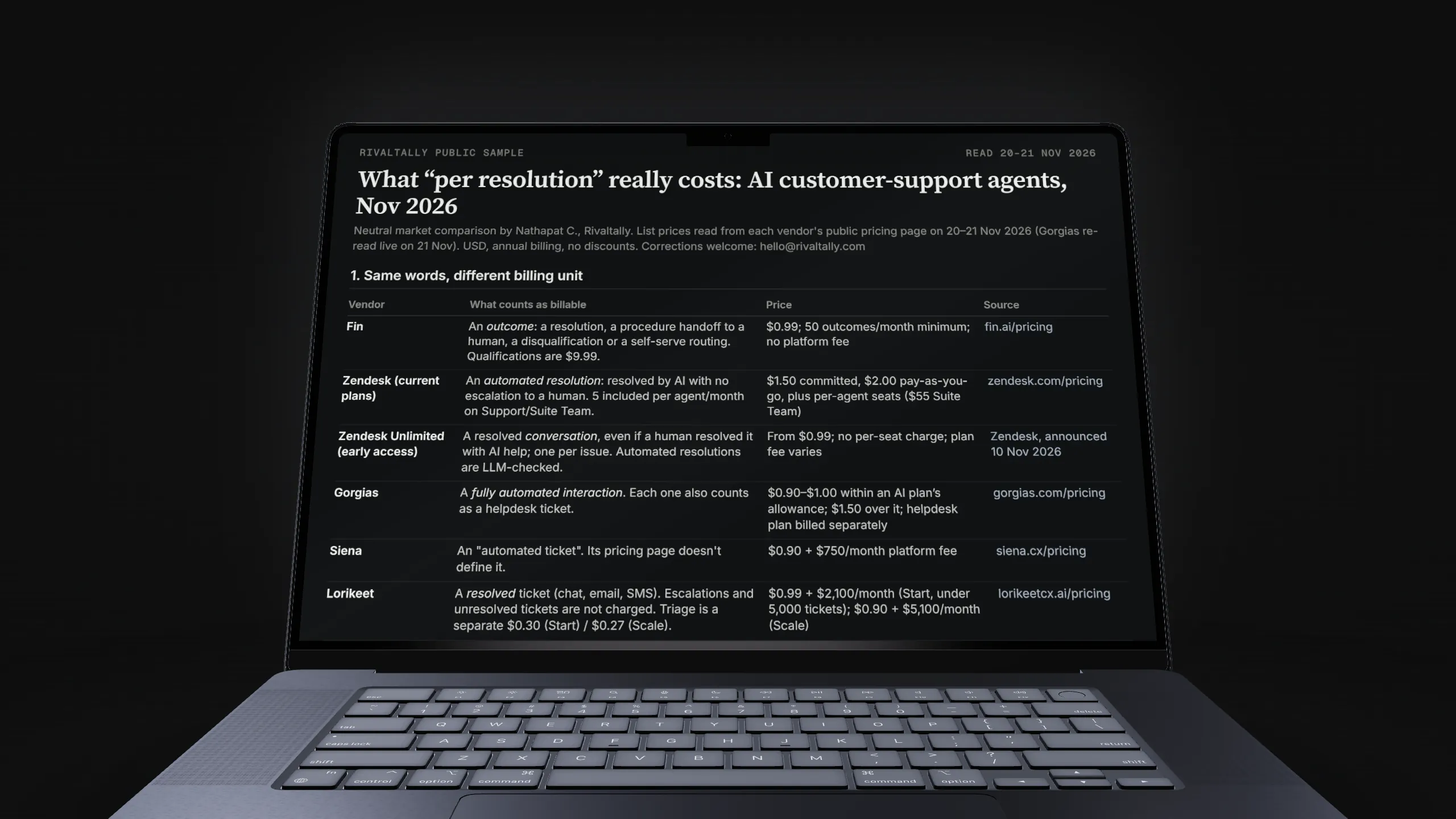
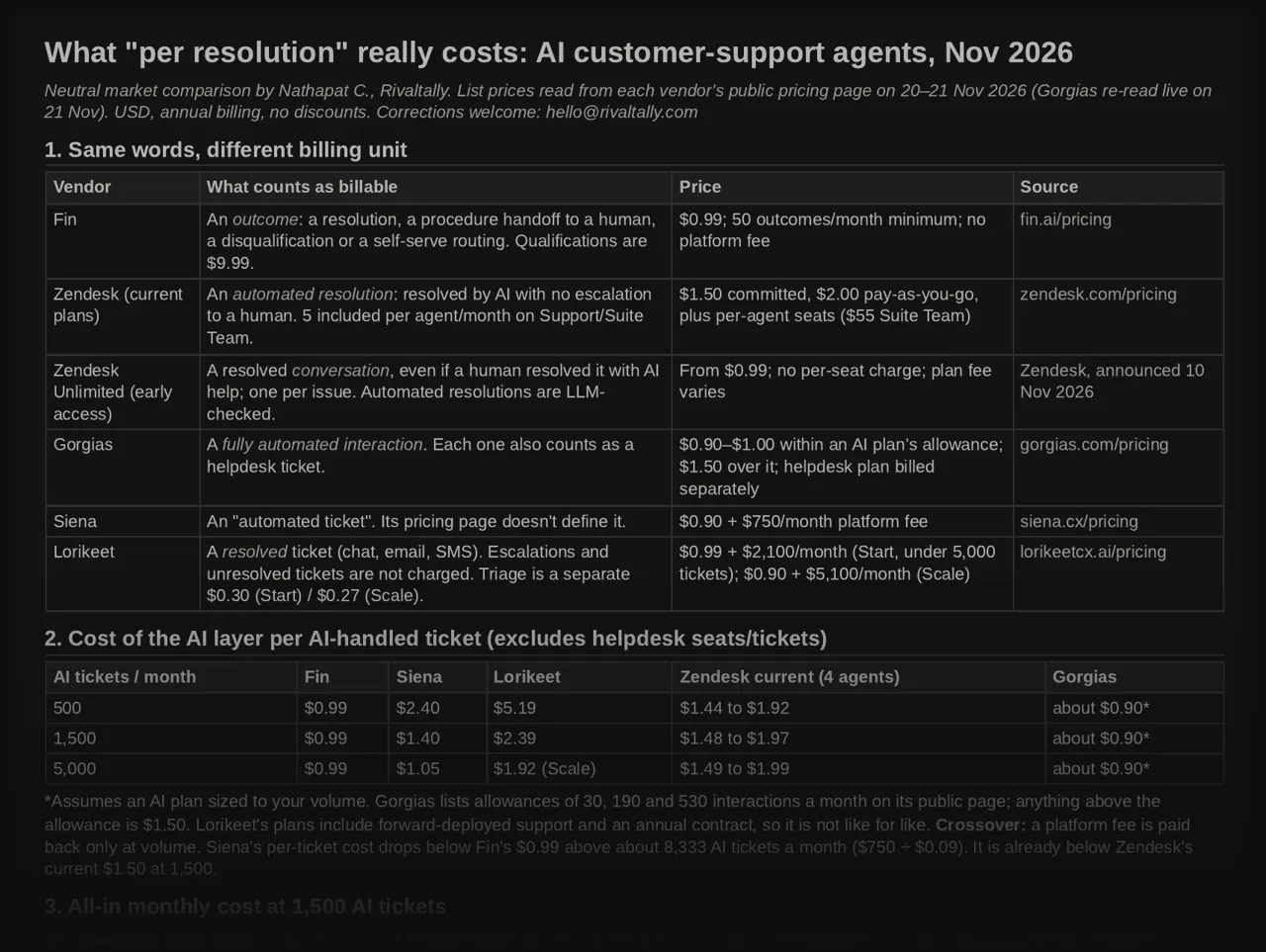
What “per resolution” really costs. Six vendors say “per resolution”. They bill six different things. This one-pager puts Fin, Zendesk, Gorgias, Siena and Lorikeet side by side: what each counts as billable, what the AI layer costs at 500, 1,500 and 5,000 tickets a month, and four questions to ask before you trust any quote.
Read the sampleDownload the PDF
List prices read from each vendor’s pricing page on 20–21 Nov 2026. Every figure is linked to its source.
Your reps hear competitor prices before you do
In AI support, pricing changes month to month. Zendesk announced outcome pricing from $0.99 on 10 Nov. Fin bills handoffs to a human as outcomes. Gorgias counts every AI interaction as a helpdesk ticket too.
A prospect quotes one of these numbers on a call. Your rep either guesses, or says “let me check”. Neither wins the deal.
Most teams your size don’t have a competitive-intel analyst, and a CI platform still needs someone to run it. So the battlecard gets updated once a quarter, if at all.
1
One email. No calls, no logins, no access to your systems.
2
Pricing, packaging, launches, changelogs, job posts. Each change is re-opened at the source, quoted and dated.
3
What changed, why it matters in a deal, how to answer, and what not to claim.
Weekly brief, one page
What changed at each competitor this week, with links and dates. If nothing changed, I say so in one line.
Battlecard, kept current
What prospects say, a sourced answer, and a “do not claim” column so reps don’t overstate.
All-in cost comparisons
Your price against theirs at real volumes, with every assumption written down.
Questions answered within 1 business day
“We’re up against X tomorrow, what do we say?”
Primary sources only
Prices come from the vendor’s own pricing page, docs or press release, never from a roundup when the original is available.
Quoted and dated
Every figure links to the page it came from and shows the date I read it.
“Do not claim” is part of every battlecard
A wrong claim on a call costs more trust than it wins.
Vendor claims are labelled
“76% resolution rate” is the vendor’s claim, and the brief says so.
Assumptions are written down
Any cost comparison states the volume, plan and billing terms behind it.
Corrections are public and fast
If you find an error, I fix it and tell you what changed.
B2B SaaS with 50–200 staff, selling through demos and sales calls.
CX, AI support, helpdesk, chatbot, voice AI or e-signature.
Competitors who change pricing or packaging often.
No dedicated CI analyst, or one who’s stretched thin.
Self-serve products with no sales team. Battlecards won’t move your numbers.
Teams that need sales-call recordings analysed or competitors mystery-shopped. Bigger agencies do this; I don’t.
Anyone who wants competitors’ private or non-public data. I only use public sources.
Rivaltally is new. There are no customer logos on this page because there aren’t any yet, and I won’t invent them. What I can offer instead:
Judge the work before paying
The free teardown is the real format, about your real competitors.
Every claim is checkable
If a number can’t be traced to a public page, it isn’t in the brief.
A paid pilot with a refund
Four weeks. If the first brief isn’t useful, tell me within 7 days and you get your money back.
No lock-in
After the pilot it’s month to month, with 30 days’ notice.
I started Rivaltally because competitor pricing in SaaS has become hard to compare. The same word, “resolution”, “seat”, “outcome”, means different things on every pricing page, and sales teams end up comparing different units.
I’m Nathapat, and I run Rivaltally on my own from Bangkok. I use AI tools to gather and draft, and I personally re-open every source and check every number before anything reaches you. Being in Bangkok means a question you send in the US evening is usually answered by your morning.
If you find a mistake in anything I send, email me. I’ll fix it and tell you what changed.
One page, up to 3 competitors, once per company.
Four weeks on 3 competitors, credited to your first month if you continue.
The weekly brief and battlecard for up to 5 competitors, month to month.
I check each competitor’s public pages every week. The numbers come from the vendor’s own public pages: pricing, docs, changelogs, press releases and job posts. Each figure is linked and dated. If I use a third-party source, it’s labelled as one.
Yes, when a person checks it. I use AI to collect pages and draft summaries. I check every number and quote against the live source myself before anything is sent. AI never decides what goes into a brief unchecked.
Email me. I correct it in the same brief, note what changed, and tell you if a battlecard line was affected.
Yes. Anything written for your company is for your team only. I sometimes publish neutral market comparisons, like the sample above, and they never include anyone’s private brief or battlecard.
No. I use public sources only. All you share is the list of competitors you care about.
Klue and Crayon are software platforms that someone on your team has to run. I do the research and hand you the finished brief and battlecard.
One page on up to 3 competitors, once per company, sent to a business email within 2 business days. There’s no catch: if you like it, the pilot is the next step. If not, there’s no follow-up sequence.
I’m in Bangkok (UTC+7). Briefs arrive on a fixed weekday, and questions sent during the US or European workday are usually answered by your next morning.
See it on your competitors first
Email me your company name and up to 3 competitors. You’ll get a sourced one-page teardown within 2 business days. Free, no call.
hello@rivaltally.com
One page, up to 3 competitors, once per company. Business email only, so no Gmail or Yahoo addresses.